Ship Faster. Detect Earlier. Recover Automatically.
Infrastructure and delivery pipelines where anomaly detection, predictive scaling, and automated incident response catch problems before they become outages.
AI anomaly detection, predictive scaling, automated incident response.
What Is DevOps?
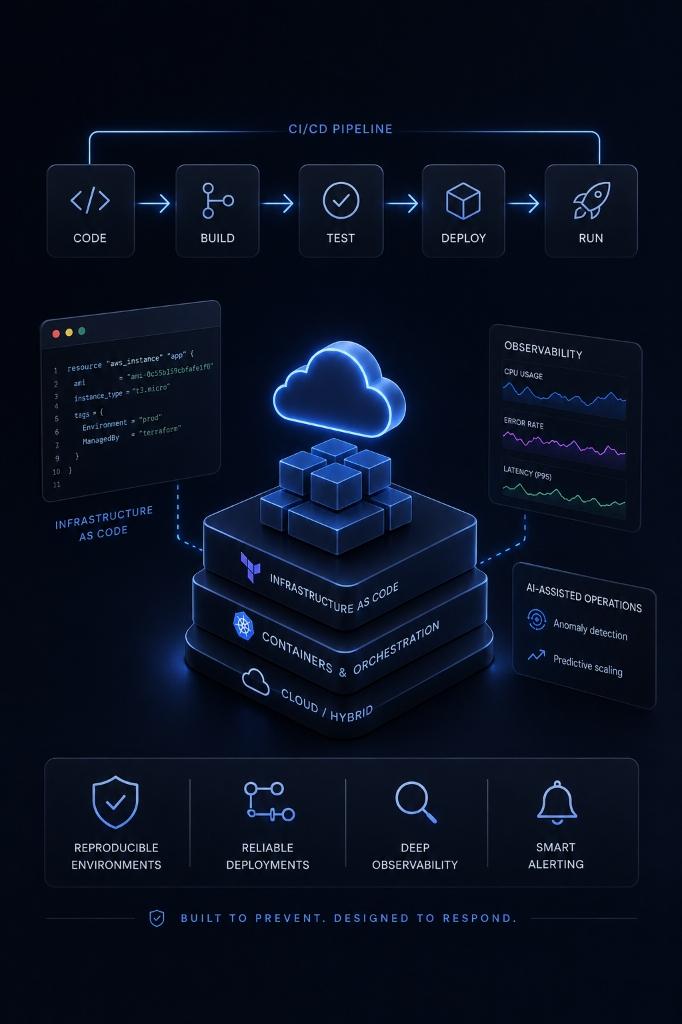
DevOps covers the infrastructure, deployment pipelines, and observability that decide whether shipping code is routine or a source of anxiety. Infrastructure as code, CI/CD that runs without babysitting, and monitoring that tells you about a problem before your customers do.
Teams need this when deploys have become risky enough that releases slow down instead of speed up, when an incident's root cause takes hours to find because observability is an afterthought, or when infrastructure has grown organically into something nobody fully understands anymore.
The traditional model is reactive: an alert fires after something's already broken, and someone gets paged to figure out why. AI-assisted operations shift that earlier with anomaly detection that flags unusual patterns before they cause an outage, and predictive scaling that adjusts capacity ahead of a load spike instead of during one.
We build infrastructure as code from the start, so environments are reproducible and reviewable, and layer observability and incident automation on top so a 3am page is the exception, not the routine.
AI turns operations from reactive monitoring into predictive engineering.
AI Anomaly Detection
Unusual patterns in traffic, error rates, and resource usage are flagged against learned baselines, catching problems before they trip a threshold alert.
Predictive Scaling
Infrastructure scales ahead of predicted demand, not purely reactive autoscaling triggered after the spike has already started.
Automated Incident Response
Common failure patterns trigger automated remediation (restarts, rollbacks, failovers) before a human needs to be paged for something the system can fix itself.
Faster, Safer Deploys
CI/CD pipelines with automated testing and rollback let your team ship more often with less risk per release, not less often to reduce risk.
What takes traditional agencies 3–6 months, DevExcel compresses into 4–8 weeks with AI-powered development.
Technical Deliverables
Reproducible, version-controlled infrastructure via Terraform, so environments are consistent and changes are reviewable.
Automated build, test, and deploy pipelines with rollback built in, not bolted on after a bad release.
Metrics, logs, and traces wired into dashboards and alerting that reflect what actually matters to your product.
Automated response for known failure patterns, with clear escalation paths for anything that needs a human.
Process Deliverables
We review your current infrastructure, deployment process, and incident history to find where risk is actually concentrated.
Fixed scope covering infrastructure, pipelines, and observability, with clear success metrics agreed upfront.
Pipeline and infrastructure changes are validated in staging and reviewed with your team before touching production.
Runbooks and a working session with whoever owns operations day-to-day after the engagement ends.
Every engagement is scoped to your project. These are typical deliverables, confirmed in the discovery call.
Engineering Lead Where Deploys Have Become Risky
Releases have slowed down because every deploy carries real risk of breaking something in production.
Team Without Real Observability
When something breaks, finding the root cause takes hours because logs, metrics, and traces live in disconnected places.
Startup Whose Infrastructure Grew Organically
Infrastructure was built incident by incident, with no one holding the full picture of how it fits together.
Sound Familiar?
Let's Talk Business→Discovery Call
We audit your current infrastructure, deployment process, and past incidents to understand where the actual risk lives.
Proposal & Scoping
A fixed-scope plan covering infrastructure as code, CI/CD, and observability, agreed before any changes touch production.
Build
Infrastructure and pipelines are built and validated in staging first, in reviewable, incremental changes.
Delivery
A phased cutover to the new infrastructure and pipelines, with rollback plans at every step.
Support
Ongoing monitoring, on-call support, and infrastructure evolution as your product and traffic grow.
Most projects complete Steps 1–4 in 4–8 weeks. Traditional agencies often take 3–6 months.
Ready to Talk About DevOps?
Tell us about your project on a discovery call, and we'll help you scope the right approach, honestly.