Modernize Legacy Systems Without Putting the Business on Hold.
Legacy modernization staged in phases: dependency mapping, data migration, and an AI-assisted readiness assessment that identifies the highest-value path first, so the business keeps running throughout.
AI readiness assessment, AI-assisted legacy migration.
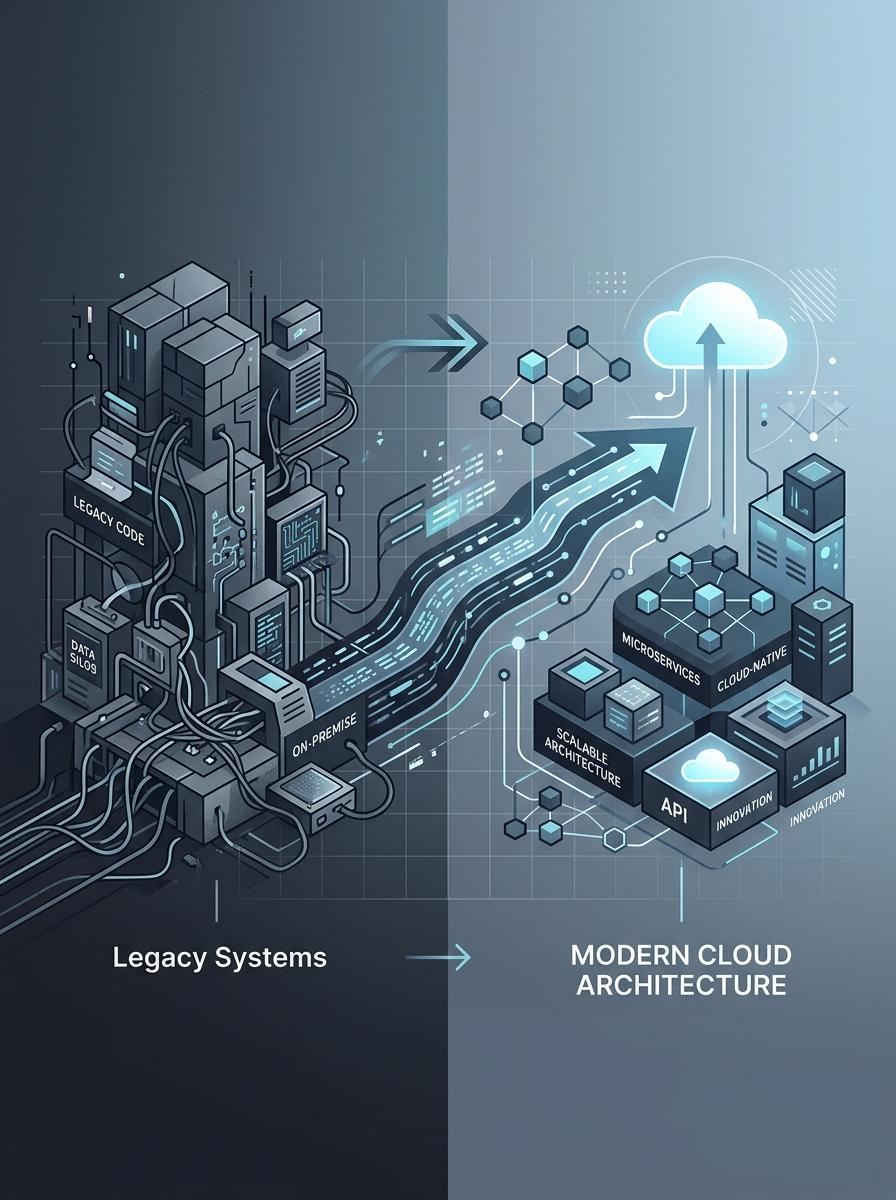
What Is Digital Transformation?
Digital Transformation is the work of moving a business off systems that have become the constraint on growth (such as legacy applications, undocumented integrations, and data trapped in formats or platforms nobody wants to touch) without stopping the business those systems currently run.
This is needed when a legacy system is the reason new features take months instead of weeks, when the people who understood the original codebase have left and nobody's fully sure what depends on what, or when a platform migration (such as on-prem to cloud, or monolith to services) has been deferred for years because the risk of doing it always seemed to outweigh the pain of not doing it.
The failure mode for big-bang legacy rewrites is well known: months of work, a hard cutover, and a business that stops functioning if anything goes wrong. We migrate incrementally by mapping dependencies first, then modernizing in phases that each ship value and can be rolled back independently.
AI accelerates the parts of this that are usually the slowest by hand: reading and documenting undocumented legacy code, mapping dependencies across systems nobody's diagrammed in years, and assessing which parts of the system are the highest-value, lowest-risk place to start.
AI helps untangle legacy systems and identify the highest-value modernization path.
AI Readiness Assessment
Legacy code and system dependencies are analyzed and mapped with AI assistance, surfacing what a manual audit would take weeks to document.
AI-Assisted Legacy Migration
AI helps translate and refactor legacy code into the modern stack, with every migrated component reviewed by an engineer before it's trusted.
Incremental Modernization
The system is migrated in phases that each ship independently, instead of one high-risk cutover that has to work perfectly the first time.
AI-Ready Foundation
The modernized system is architected so AI-relevant capabilities, such as automation and intelligent features, can be added later without another rebuild.
What takes traditional agencies 9–18 months, DevExcel compresses into 8–12 week phases with AI-powered development.
Technical Deliverables
A documented map of what the legacy system actually depends on, built with AI-assisted code analysis, not tribal knowledge.
Modernized components delivered phase by phase, each reviewed and production-tested before the next phase begins.
A tested, reversible pipeline for moving data out of legacy storage into the modernized system without data loss.
New and legacy systems interoperate cleanly during the transition, so nothing has to go dark mid-migration.
Process Deliverables
We map the legacy system's dependencies and assess which components are the highest-value place to start.
A phased migration plan with clear scope and success criteria for each phase, agreed before work begins.
Each phase delivers a working, tested improvement your team can validate before the next phase starts.
Documentation of the modernized system and a working session so your team understands what changed and why.
Every engagement is scoped to your project. These are typical deliverables, confirmed in the discovery call.
Team Stuck on a Legacy System Slowing Every Release
Every new feature takes months because it has to work around a system nobody wants to touch.
Business Whose Original Engineers Are Long Gone
The people who built the current system left years ago, and nobody's fully sure what depends on what anymore.
Company That's Deferred a Cloud or Platform Migration for Years
An on-prem-to-cloud or monolith-to-services migration keeps getting pushed because the perceived risk always outweighs the pain of not doing it.
Sound Familiar?
Let's Talk Business→Discovery Call
We review the current system, its dependencies, and the business risk of leaving it as-is versus modernizing.
Proposal & Scoping
A phased migration plan with the highest-value, lowest-risk phase identified first, and clear success criteria per phase.
Build
Each phase is built, tested, and validated against the legacy system's real behavior before it's trusted with production data.
Delivery
Phased cutover with the legacy and modernized systems running in parallel until the new phase is proven.
Support
Ongoing support through subsequent phases and after the full migration is complete.
Most projects complete Steps 1–4 in 8–12 weeks per phase. Traditional agencies often take 9–18 months for the full migration.
Ready to Talk About Digital Transformation?
Tell us about your project on a discovery call, and we'll help you scope the right approach, honestly.