Multi-Tenant Products Built to Scale from the First Customer.
AI-native SaaS architecture featuring multi-tenancy, permissions, billing, and data isolation designed in from day one instead of retrofitted after growth exposes the gaps.
AI-native architecture from the first customer, not the hundredth.
What Is SaaS Development?
SaaS is a different engineering problem than a single-tenant application. Every architectural decision (how data is isolated, how permissions cascade across roles and organizations, how billing ties to usage) has to hold up not just for your first customer, but for your thousandth, without a rebuild in between.
Businesses need this when a single-customer product is becoming a platform, when an internal tool is being productized for external customers, or when the founding team knows the market but hasn't yet built for genuine multi-tenant scale.
The mistakes that sink SaaS products are architectural, not cosmetic: data isolation bugs that leak one tenant's data into another's view, a billing model bolted on after launch, and permission systems that don't map to how real organizations are structured. These are expensive to fix retroactively and cheap to get right from the start.
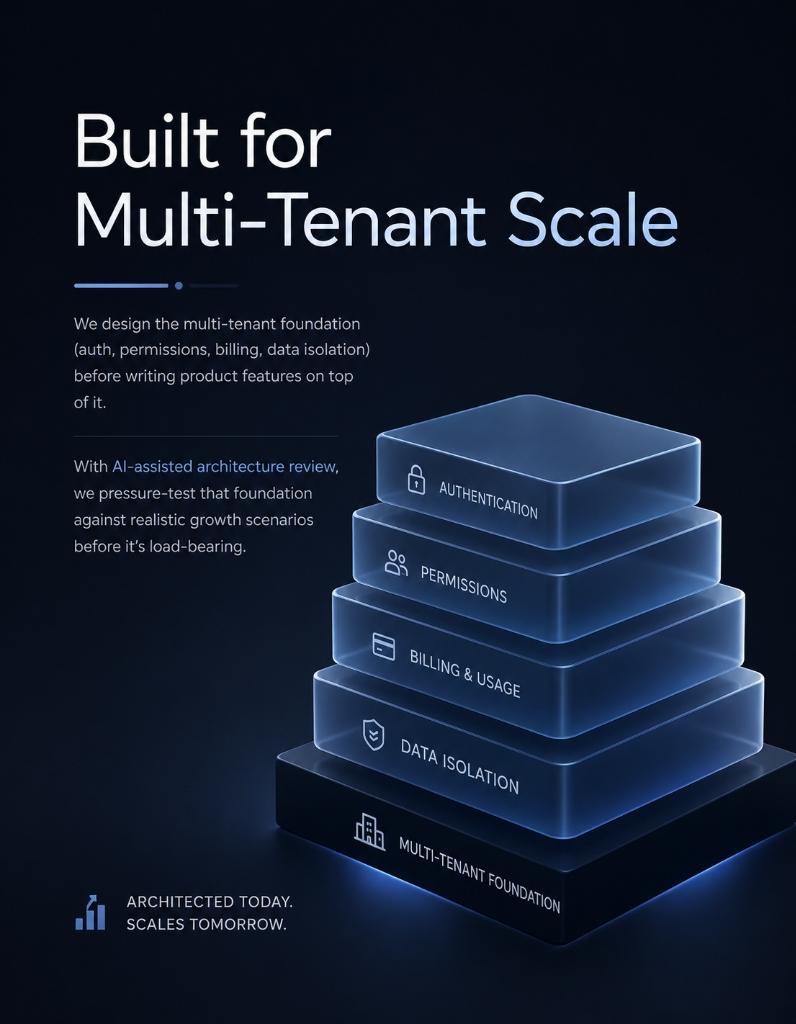
We design the multi-tenant foundation (auth, permissions, billing, data isolation) before writing product features on top of it, and use AI-assisted architecture review to pressure-test that foundation against realistic growth scenarios before it's load-bearing.
AI is designed into the product architecture from day one.
AI from Day One
AI-relevant product surfaces, such as recommendations, search, and automation, are architected in from the start where they fit the product, not bolted on after the fact.
Multi-Tenant Foundations
Data isolation, role-based permissions, and organization structure are designed before a single feature is built on top of them.
AI-Assisted Architecture
The tenancy, billing, and permission model is pressure-tested against realistic multi-customer growth scenarios before it goes live.
Faster to Revenue
A production-ready multi-tenant foundation means the first paying customers can onboard without a re-architecture blocking the second.
What takes traditional agencies 6–9 months, DevExcel compresses into 8–12 weeks with AI-powered development.
Technical Deliverables
Data isolation and organization structure designed to hold at scale, not just for a demo tenant.
Role-based access control that maps to how real customer organizations are structured, including team and workspace hierarchies.
Usage-based or seat-based billing wired into the product from launch, not added after the first customer asks for an invoice.
Tenancy isolation and permission boundaries are the most tested paths in the codebase, given what a failure there costs.
Process Deliverables
We map the tenancy model, permission structure, and billing logic your actual customers will need.
Fixed scope covering the full multi-tenant foundation plus your core product features, agreed before build starts.
The tenancy and permission foundation is demoed and validated before product features are layered on top.
Documentation covering the tenancy model and billing integration, so your team can safely extend it.
Every engagement is scoped to your project. These are typical deliverables, confirmed in the discovery call.
Founder Turning a Single-Customer Product into a Platform
One customer's custom build is being generalized into something multiple organizations can use.
Team Productizing an Internal Tool
An internal system built for one department is being opened up to external customers.
Founder Who Knows the Market but Not Multi-Tenant Architecture
The product vision and customer demand are clear; the engineering foundation to support multiple paying organizations isn't.
Sound Familiar?
Let's Talk Business→Discovery Call
We understand your customer segments, org structures, and billing model to design tenancy correctly from the start.
Proposal & Scoping
A fixed-scope plan covering the multi-tenant foundation and the product features built on top of it.
Build
Tenancy, auth, and billing are built and validated first; product features follow in demoable increments.
Delivery
Production deployment with the tenancy and permission model tested against realistic multi-org scenarios.
Support
Ongoing support as customer count and org complexity grow past what the first cohort looked like.
Most projects complete Steps 1–4 in 8–12 weeks. Traditional agencies often take 6–9 months.
Ready to Talk About SaaS Development?
Tell us about your project on a discovery call, and we'll help you scope the right approach, honestly.